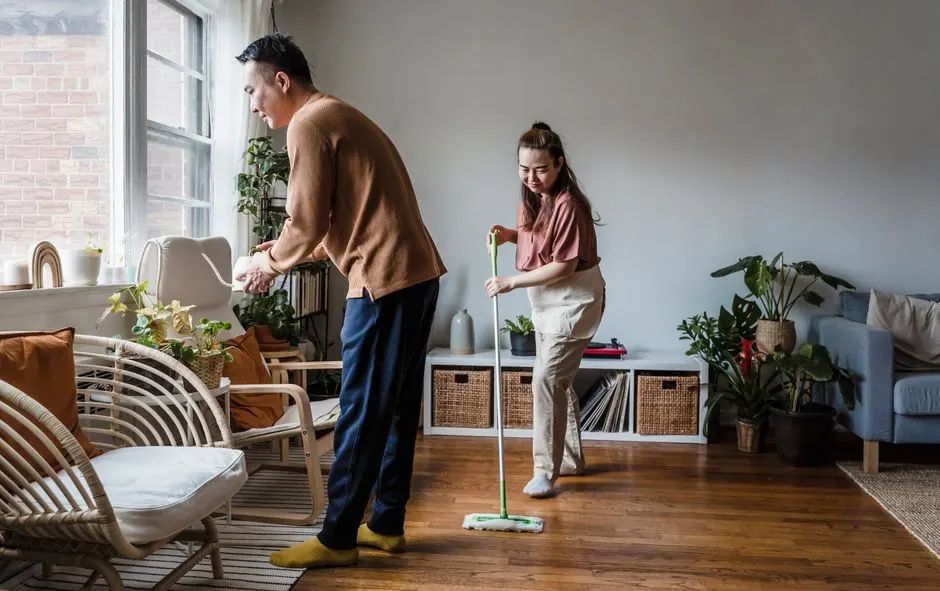
Your wood floors are turning gray after mopping because water is getting past the finish and reaching bare wood, where it lifts the natural tannins and leaves that washed-out, ashy look. In Austin, where indoor humidity swings from 30% in February to 70% in September, a damp mop that would be harmless in a drier climate can push moisture into every scratch and seam. The gray is not dirt - it is damaged wood fiber. This post explains exactly why it happens here, how to tell whether you can fix it yourself, and when it is time to call someone.
Why mopping turns wood floors gray in Austin
Wood floor graying mopping Austin homeowners deal with almost always traces back to one thing: the finish has stopped doing its job. A factory or site-applied finish - polyurethane, aluminum oxide, or hardwax oil - is a thin barrier, usually 2 to 4 mils thick. Once that barrier wears through in traffic lanes, water from a mop goes straight into the wood.
Wet wood does two things. First, it swells and then dries, and that cycle raises the grain. Second, moisture pulls natural color compounds out of the cells and leaves behind a gray, silvery surface - the same effect you see on an old untreated fence. It is not a stain you can scrub away. It is the wood itself changing.
The other big contributor is the mop water itself. Most people use too much. A string mop soaked and wrung once leaves a film of water that sits on the floor for 10 to 15 minutes. On a sealed floor that is survivable. On a floor with worn finish, that is enough time for water to wick into every seam between boards.
The Austin-specific causes nobody warns you about
Austin's climate does more damage to wood floors than most homeowners expect. Here is what we see on service calls across the metro.
Humidity swings
Central Texas averages 65% relative humidity in spring and fall, then drops to 35% or lower during winter cold fronts. Wood expands and contracts with those swings. Every expansion cycle opens microscopic gaps at board edges, and every gap is a doorway for mop water. Homes in Wood Flooring in Circle C and other 1990s-2000s subdivisions are especially prone because many were built with 3/4-inch solid oak over slab, and slab moisture moves up through the floor seasonally.
Slab foundations
Most Austin homes sit on post-tension slabs. Concrete wicks groundwater and releases it as vapor - typically 3 to 5 pounds per 1,000 square feet per 24 hours. If the floor was installed without a proper 6-mil vapor barrier, that moisture enters from below. Mopping just adds to a problem that is already happening.
Hard water
Austin Water runs 8 to 12 grains per gallon of hardness. That calcium and magnesium leaves a chalky film on the finish. Over a year or two, that film dulls the surface and makes any gray underneath look worse. It also makes the finish more porous, so the next mop pushes more water in.
How to tell if the gray is surface-level or deep in the wood
Before you spend money on a fix, figure out which problem you have. The test takes two minutes.
- Wipe a small area with a damp cloth and a drop of dish soap. If the gray lifts, it is residue - hard water film, old cleaner, or mop soap buildup. If it stays, the wood itself is affected.
- Look at the edges of the boards. Gray concentrated along seams and in traffic lanes means the finish is worn through. Gray across the entire board, evenly, usually means moisture from below or a finish that has failed everywhere.
- Run a fingernail across the surface. If it catches on raised grain, the wood has absorbed water and swelled. That is a refinish job, not a cleaning job.
- Check for cupping. If board edges are higher than the centers, moisture is coming from underneath. That is a bigger issue than mopping.
If you are not sure, we will tell you honestly on a walkthrough. We have been doing Wood Flooring Austin TX long enough to know when a floor needs a $200 cleaning and when it needs a full sand-and-refinish.
How to fix gray wood floors in Austin Texas
The right fix depends on how deep the gray goes. Here is the order we recommend, from cheapest to most involved.
1. Deep-clean with a wood-safe cleaner
If the gray is residue, a pH-neutral wood floor cleaner and a microfiber mop will lift it. Use a 32-ounce spray bottle, mist a 4x4 section, and dry it immediately with a clean towel. Do not soak. Cost: $15 to $25 for supplies. Time: one afternoon for 800 square feet.
2. Screen and recoat
If the finish is worn but the wood underneath is still sound, a screen-and-recoat adds a fresh layer of polyurethane without sanding down to bare wood. We use a 220-grit screen, vacuum, tack, then apply two coats of water-based finish. Typical 2026 pricing in Austin runs $1.75 to $2.75 per square foot. Time: 2 days, including cure.
3. Full sand and refinish
When gray has penetrated the wood fibers, you have to remove the top 1/32 to 1/16 inch of the board. That is a full hardwood floor refinishing Austin TX job. Cost in 2026: $3.50 to $5.50 per square foot for standard oak, more for exotic species or complex layouts. Time: 3 to 5 days depending on square footage and finish cure.
4. Replace boards that are too far gone
Boards with rot, severe cupping, or pet stains that have gone black cannot be refinished. We cut them out and lace in matching stock. Expect $250 to $600 per board depending on species and whether we can source a match. If you are already planning a bigger change, this is a good time to consider a floor staining and color change Austin TX to update the whole floor at once.
How to mop wood floors without causing graying
The mop you use matters more than how often you use it. Here is what we tell every customer after a refinish.
- Use a microfiber flat mop, not a string mop. String mops hold water and release it unevenly. Microfiber releases a thin, even film.
- Wring until it stops dripping. If you can see water on the floor, you are using too much.
- Mist, do not flood. A spray bottle gives you control. Two or three sprays per 4x4 section is plenty.
- Dry immediately. Follow the mop with a dry microfiber towel. The floor should be dry within 60 seconds.
- Skip vinegar, ammonia, and steam mops. Vinegar etches aluminum oxide finishes. Ammonia dulls polyurethane. Steam pushes moisture into seams. None of them belong on a wood floor.
- Clean spills within 5 minutes. Standing water is the enemy. Blot, do not wipe.
If your floors are in a high-traffic rental or a commercial space, the same rules apply but more often. We handle commercial wood flooring Austin TX for restaurants and offices, and the number one cause of graying we see is a nightly string-mop routine that puts down more water than the finish can handle.
Common mistakes that make graying worse
We see these on almost every call. Avoid them and your floors will last years longer.
- Mopping more often to fix the gray. More water makes it worse. If the gray is not lifting with a dry microfiber, stop mopping and call someone.
- Using an all-purpose cleaner. Kitchen and bathroom cleaners contain surfactants that leave a film and break down finish. Use a product labeled for wood floors.
- Letting water sit. A puddle left for 20 minutes can leave a permanent white ring or a gray patch. Blot it up.
- Ignoring humidity. Running a dehumidifier in summer and a humidifier in winter keeps indoor RH between 35% and 55%, which is the range wood floors want. A $150 dehumidifier prevents $3,000 in refinishing.
- Putting off the recoat. A $400 screen-and-recoat now saves a $3,500 refinish later. When the finish starts looking dull in traffic lanes, that is your signal.
When to call a professional
Call us when the gray does not lift with a damp microfiber and a wood-safe cleaner, when you see cupping or raised seams, or when the floor has not been refinished in more than 10 years. Those are all signs the finish has failed and the wood is taking on moisture.
We start every job with a walkthrough. We will tell you whether you need a $200 cleaning, a $1,200 recoat, or a full refinish - and we will show you the test spots so you can see the difference before you commit. If you are in Wood Flooring in Westlake or anywhere in the Austin metro, we can usually get out within a week.
Frequently Asked Questions
Why are my wood floors turning gray after mopping in Austin TX?
Water is reaching bare wood through worn finish or open seams. Austin's humidity swings and hard water accelerate it. Once the finish is compromised, every mop pushes moisture into the grain, which lifts color and leaves gray. A screen-and-recoat at $1.75 to $2.75 per square foot usually fixes it.
How do I fix gray wood floors in Austin Texas?
Start with a pH-neutral cleaner and a dry microfiber. If the gray stays, the finish is worn - a screen-and-recoat runs $1.75 to $2.75 per square foot in 2026. If the gray is in the wood itself, a full refinish at $3.50 to $5.50 per square foot is the fix. Most Austin jobs take 2 to 5 days.
Does mopping cause wood floor graying in Austin?
Mopping does not cause graying by itself - it accelerates it. A damp microfiber mop on a healthy finish is fine. A wet string mop on a worn finish pushes water into the wood, and that is what turns it gray. The fix is less water, not less cleaning.
Can gray wood floors be refinished in Austin TX?
Yes, in almost every case. If the gray is in the top 1/32 inch of the board, sanding removes it and a new finish seals the wood. Boards with rot or black pet stains may need replacement at $250 to $600 each. We can tell you which you need after a 15-minute walkthrough.
How often should I mop wood floors in Austin?
Once a week for most homes, and spot-clean spills within 5 minutes. In summer, when indoor humidity climbs, cut back to every 10 days and run a dehumidifier to keep RH between 35% and 55%. Over-mopping is more common than under-mopping, and it is the main driver of graying.
Get help with Wood Flooring in Austin
If your floors have gone gray and a damp microfiber is not bringing them back, we can tell you exactly what is happening and what it will take to fix it. Call General Wood Flooring LLC at 512 877 7960 for a walkthrough and an upfront price.